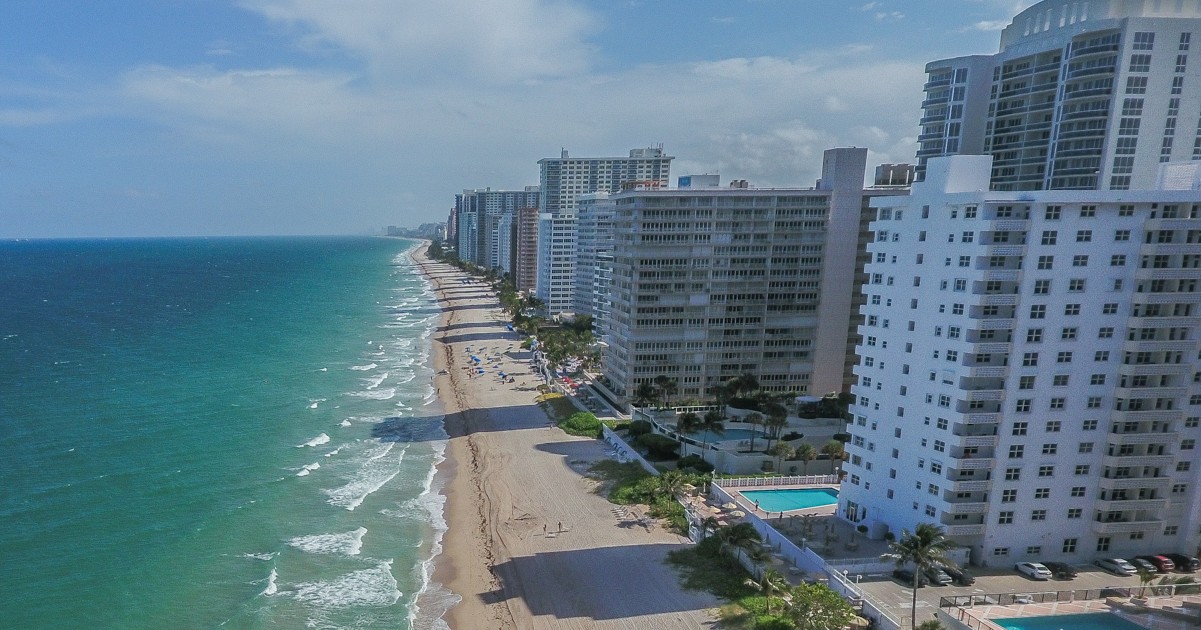
What You Should Know Before Buying a Beachfront Condo in South Florida
If you’re thinking about buying a condo along the South Florida coast — or even if you already own one — you’ve probably noticed how much more attention building safety, structural maintenance, and reserve funding have been getting in the past few years.
Between stricter state laws, rising association fees, and the lingering memory of Champlain Towers South, today’s buyers are asking smarter and more important questions than ever before.
Part of this growing awareness comes from recent research by the University of Miami and other institutions. They used satellite data to measure subsidence (very slow ground settling) in certain coastal areas.
Their analysis, covering 2016–2023, found 1–3 inches of vertical ground movement beneath several high-rise buildings in Sunny Isles, Bal Harbour, Surfside, and Miami Beach.
Now, 1–3 inches may not sound dramatic, but in the world of concrete high-rises, it can matter — especially depending on how the ground moves.
Uniform settling (the entire structure sinking evenly) can be normal.
Uneven settling (one side sinking more than another) can stress columns, slabs, waterproofing, and plumbing.
The study didn’t determine whether the movement was uniform or uneven — and that distinction is crucial. After the Champlain Towers South collapse in 2021, which killed 98 people, South Florida condo owners and buyers are more aware than ever that even small changes can become significant over time.
To be clear, the research does not claim any building is unsafe — but it highlights why ongoing monitoring, inspections, and transparency matter.
What About Broward County?
Since I primarily work with condo buyers and sellers in Broward County, one of the first things I looked for was whether similar studies exist for our beachfront buildings.
Right now, the answer is no.
Broward was not included in the satellite analysis, and there are no published studies measuring ground movement for:
• Fort Lauderdale
• Hollywood
• Pompano Beach
• Lauderdale-by-the-Sea
• Hillsboro Beach
This doesn’t mean Broward is safer or riskier — it simply means we don’t have the same data yet.
And Broward faces many of the same conditions:
• older coastal construction
• similar soil and geology
• years of salt exposure and storms
• and the same statewide inspection and reserve requirements
Until Broward has its own analysis, due diligence is essential.
The Bigger Picture: Safety, Inspections, and Rising Condo Costs
After Champlain, Florida introduced stricter building-safety laws requiring:
• milestone structural inspections
• structural integrity reserve studies
• fully funded reserves for critical components
These laws are necessary — but they also uncovered something difficult. Many buildings were not financially prepared for the repair requirements that these inspections revealed.
For many years, associations were legally allowed to waive reserves. Many did — not irresponsibly, but because the law allowed it and many residents relied on keeping monthly fees affordable.
Combine that with:
• rising homeowners insurance
• inflation
• construction labor shortages
• aging concrete
• decades of coastal wear
…and buildings are now facing major repairs all at once.
As a result, many condo owners are seeing fees rise to $900–$1,600+ per month, and special assessments reach tens or hundreds of thousands of dollars. Long-time residents, especially retirees on fixed incomes, are struggling or being forced to sell.
When you combine aging buildings, increasing repair needs, new state requirements, and now data showing measurable ground movement — even slow movement — it becomes clear why condo buyers need to evaluate both the structural and financial health of any building they’re considering.
What Condo Buyers Should Know Before Purchasing
I’ve been a Realtor in South Florida since 1998, and one thing I always tell buyers is this:
Buying a condo requires deeper due diligence than buying a single-family home.
You’re not just buying your unit. You’re buying into:
• the building’s maintenance history
• its structural condition
• its upcoming repair needs
• and the financial decisions of the association
I’m not here to talk anyone out of condo living — many people love it. But I do want buyers to be protected.
Here are important questions to ask:
• Have the building’s milestone inspections been completed yet (based on its age), and what were the results?
• Are reserves fully funded?
• Are any special assessments coming?
• When were the last major repairs completed?
• Are major repairs planned for the next few years?
• What do the association’s financials look like?
• Has maintenance been deferred in the past?
• Is the board addressing issues proactively?
The more you know upfront, the better your long-term outcome will be.
Want to Read the Study Yourself?
https://agupubs.onlinelibrary.wiley.com/doi/10.1029/2024EA003852
If You’re Thinking About Buying Along the Broward Coast…
Whether you’re exploring a beachfront condo, townhouse, or single-family home, I’m here to help you navigate the details so you can make a safe, confident, well-informed decision.
With over 25 years of experience in South Florida real estate, I’m always happy to review building documents, financials, inspections, and anything else you may need.
Debbie Bates, Realtor®
Call/Text: 954-557-7036
Email: debbie@SouthFLHomes.com
Search for Homes: www.SouthFLHomes.com